
Andrew Pittet
July 16, 2026



A Wider Field of Winners
“No player is bigger than the club” - Sir Alex Ferguson, professional soccer player and Manchester United manager
June and July are big months for soccer fans, with the World Cup drawing global attention. I have mostly been following from the sidelines, as my wife and I are raising two young kids while I manage my investment advisory practice and continue serving in the Army Reserves. Even so, one thing always stands out in every tournament: the favorites do not always win.
One example from the recent tournament was Norway’s unlikely run. The team had not qualified for a World Cup since 1998, and it faced Brazil, a country with five World Cup titles, the most in history. Norway entered the match as a clear underdog. Still, it surprised the world with a 2 to 1 win over Brazil and advanced to the quarterfinals.
Markets, much like soccer tournaments, have a way of humbling the favorites and rewarding unexpected winners.
In recent years, the U.S. stock market has been led by the “Magnificent 7,” consisting of Apple, Microsoft, Alphabet (Google), Amazon, Nvidia, Meta (Facebook), and Tesla, which grew to represent more than 30% of the market’s total value.1 Their success was driven by strong earnings growth and unusually high profit margins. On average, these companies posted profit margins of 29.1% compared with 16.1% for the broader index.2 Over the past five years, they also accounted for 29% of total market returns.3
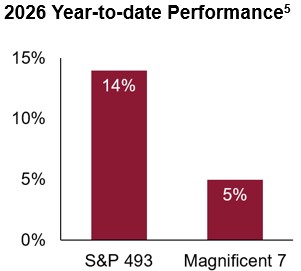
But in the first half of 2026, leadership began to change. The Magnificent 7 returned 5% while the other 493 companies in the index gained 14%. One likely reason is valuation. After years of strong performance, these large technology stocks now trade at 24.5 times earnings, compared with 18.8 times for the rest of the index.4
This recent shift might also reflect a broader change in investor thinking. Companies and sectors that had been overlooked for some time started to perform better than many expected. Some investors appear to be taking a closer look at the scale of capital spending by the largest technology firms. At the same time, the scale of investment linked to artificial intelligence may be helping not just the technology sector, but also spreading to other parts of the economy. Geopolitical uncertainty may be playing a role as well, leading some investors toward companies with lower valuations or more defensive business models.
That is why broad diversification remains so important. Building a portfolio around only one part of the market can leave investors exposed when leadership changes in unexpected ways. Unlike your World Cup pool, you do not have to pick a single team to win. You can own a broad mix of businesses and be better positioned for whatever comes next.
Stay disciplined,
-Andrew
Sources: 1,2) Yardeni Research 3) JP Morgan 4) Yardeni Research 5) JP Morgan
Related posts
Andrew Pittet
October 06, 2026
Gradually, then suddenly
Warren Buffett’s story shows why patience may be the most underrated edge in investing.
Read moreAndrew Pittet
September 09, 2026
When Bonds Start Calling the Shots
Rising long-term bond yields are reshaping markets worldwide as investors demand more compensation for debt, with important implications for stocks, governments and portfolio strategy.
Read more