
Andrew Pittet
September 09, 2026
Money Financial literacy Economy


When Bonds Start Calling the Shots
“I used to think that if there was reincarnation, I wanted to come back as the president or the pope or as a .400 baseball hitter. But now I would like to come back as the bond market. You can intimidate everybody.”
-James Carville, lead strategist for President Bill Clinton
The professional bond managers that I work with are an interesting bunch. Stock investors are usually optimists. They own part of a business, so they share in its future growth. If the business does very well, their upside can be substantial.
Bond investors see the world differently because they lend money rather than own part of a business. Their risk is lower but their return is more defined because it comes mainly from interest payments that are set in advance. For that reason, bond investors tend to focus less on the potential upside and more on two practical questions. Will they get paid? And what is the spending power of those future payments after inflation?
That mindset is now shaping the yields on long-term government bonds around the world with impacts across the financial markets. In the United States, the yield on the 30-year government bond recently reached its highest level in more than two decades. Bond yields in Japan have climbed to their highest levels since 1996, and UK yields have moved above levels last seen in 1998.1
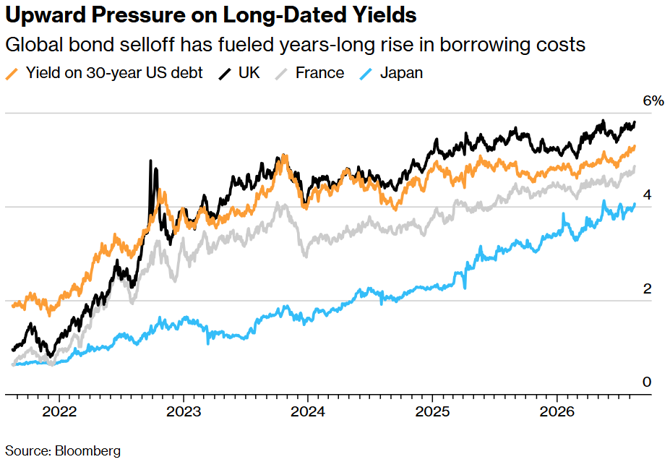
Most people are familiar with central bank interest rate announcements from the Bank of Canada or the U.S. Federal Reserve. What is often less well understood is that central banks set short term interest rates through the overnight lending rate. While that rate is important and influences borrowing costs across different time periods, in normal conditions long-term bond yields are ultimately set by investors. Through a bond auction process, the balance between bond supply and investor demand determines the interest rate paid on long-term government debt.
There are a few likely reasons why investors have been demanding higher interest rates on long-term debt.
First, government debt has risen sharply around the world. When making a loan to a counterparty with higher debt levels, investors will demand a higher return to compensate for greater risk. In the United States, federal debt has recently moved above $40 trillion. Twenty years ago, it was about $8 trillion.2
Second, inflation remains a concern. Across the OECD, inflation has risen to its highest level in two years. 3 Investors are also watching energy prices closely, especially with the ongoing conflict in the Middle East. If inflation stays elevated, the fixed payments from bonds become less valuable in real terms.
Third, governments are not the only large borrowers. Companies are also issuing more debt, which adds to the supply of bonds available to investors. When supply rises, issuers often need to offer higher yields to attract buyers. In the United States, investment grade corporate bond issuance is expected to reach a record $1.9 trillion this year.4 A lot of that borrowing is tied to heavy spending on artificial intelligence infrastructure. Large technology firms that were once cash-rich are now spending so heavily on data centers that many have turned to debt markets for funding.
Higher bond yields carry several implications for investors. The bond market can ultimately influence government policy by raising borrowing costs and pressuring leaders to change course when markets lose confidence in fiscal plans. A notable example came in 2022, when UK Prime Minister Liz Truss proposed £45 billion in unfunded tax cuts.5 Bond yields jumped, markets reacted sharply, and she left office after just 44 days. Higher yields can also put pressure on growth stocks and more speculative companies, since so much of their expected earnings lie further in the future. Finally, shorter-term bonds may offer a steadier place to invest while markets adjust, since their prices are less sensitive to rising rates and can still provide solid income.
Stay disciplined,
-Andrew
Sources: 1) The Wall Street Journal 2) US Federal Reserve 3) Bloomberg 4) The Wall Street Journal 5) The Times
Andrew Pittet is an Investment Advisor with CIBC Wood Gundy in Calgary. The views of Andrew do not necessarily reflect those of CIBC World Markets Inc. This commentary is for informational purposes only and is not being provided in the context of an offering of any security, sector, or financial instrument, and is not a recommendation of a specific investment strategy, or solicitation to buy, hold or sell any security. CIBC Private Wealth consists of services provided by CIBC and certain of its subsidiaries, including CIBC Wood Gundy, a division of CIBC World Markets Inc. The CIBC logo and "CIBC Private Wealth" are trademarks of CIBC, used under license. "Wood Gundy" is a registered trademark of CIBC World Markets Inc. If you are currently a CIBC Wood Gundy client, please contact your Investment Advisor.
Related posts
Andrew Pittet
October 06, 2026
Gradually, then suddenly
Warren Buffett’s story shows why patience may be the most underrated edge in investing.
Read moreAndrew Pittet
August 13, 2026
2026 Summer Reading List
Our summer reading list offers three smart nonfiction picks on leadership, courage, and the forces shaping today’s financial system.
Read more