
Andrew Pittet
November 09, 2026



Grey hairs, green returns
Last month I reached a milestone that required my wife to buy an extra box of candles for my birthday cake: I turned 40. So far, I seem to have avoided a midlife crisis, recently opting for a full-sized SUV with a third row for our family instead of a sports car. It likely helps that I’ve always been somewhat of an old soul (I read the newspaper at 5 a.m. every morning, and my wife tells me my sneezes get louder each year). Still, 40 does mark the start of official middle age. It also got me thinking about how companies move through their own lifecycles, and how that can shape the way we invest in them.
Aswath Damodaran, a finance professor at the NYU Stern School of Business, offers a useful framework for this. His central idea is that companies change as they age, and so do their financial traits. In the early years, a company must turn an idea into a product and then build a business model that turns that product into revenue. As it matures, its revenue growth may slow, but its cash flows often become steadier, and its focus shifts to finding good uses for its profits.
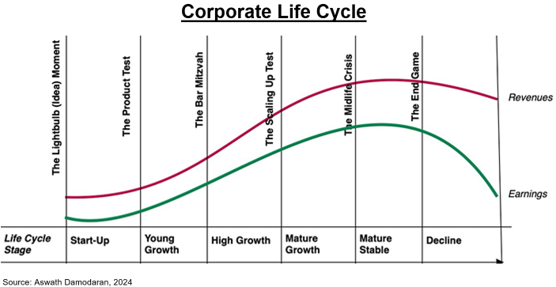
Our society pays a lot of attention to youth, and investing is no different. Growth investing looks for companies with the potential to reshape their industries through innovation, and those companies tend to be young. The challenge is that most of their value rests on a story about the future, and those stories do not always come true. Among the youngest tenth of companies, the median operating margin, which is the profit earned from daily activities for each dollar of sales, is negative 3.29%.(1) Even those companies that survive the early years can struggle to last long-term. In today's more competitive business environment, the average company in the S&P 500 stays in the index for only about 15 years (in the 1950s it was 67 years).(2)
Mature companies that have survived for decades are often less glamorous, but they can be very attractive to investors. With a longer track record, they can also be easier to value. We can study the assets and business model already in place and judge whether the price makes sense. Their steadier cash flows can also make returns more dependable for shareholders. One study found that mature companies produced average three-year total shareholder returns of 12%, while companies in their early phases lost 3%.(3)
Both people and the companies we own move through different stages of life. Youth has its advantages, but maturity has real benefits too, and investors should not overlook them.
Stay disciplined,
-Andrew
Sources: 1) Aswath Damodaran 2) EY 3) Michael Mauboussin
Related posts
Andrew Pittet
October 06, 2026
Gradually, then suddenly
Warren Buffett’s story shows why patience may be the most underrated edge in investing.
Read moreAndrew Pittet
September 09, 2026
When Bonds Start Calling the Shots
Rising long-term bond yields are reshaping markets worldwide as investors demand more compensation for debt, with important implications for stocks, governments and portfolio strategy.
Read more