







Interest Rates and AI: Making Sense of the Unknown
Rates and Reality: Focus on What You Can Control
We get asked where interest rates are headed — and what we think about AI — almost as often as we get asked about the weather. So let's tackle both.
We’re paraphrasing, but Peter Lynch has a quote we come back to often: predicting interest rates is a waste of time because if anyone could do it reliably, there'd be a lot more billionaires walking around. Even the people running the Federal Reserve will tell you plainly that they can't forecast where rates will go next. And yet we all sit glued to their announcements, parsing the difference between "adjustments" and "further adjustments," as if the wording itself were a crystal ball.
Here's what actually matters: over the long run, stock prices will very likely rise when earnings rise. If Canadian Pacific Kansas City Ltd., Dollarama Inc., or National Bank of Canada grow their profits year after year, the share prices should follow. That’s the real story, and it’s far more useful to understand than the Fed’s September 16 commentary.
If there's uncertainty in your life — and there always is — the antidote isn't predicting the unpredictable. It's focusing on what you can actually control: your cash needs, your debt levels, and how you invest money you won’t need for five to ten years.
One more thing worth repeating: the businesses providing you 24-hour financial news need your attention to survive. Their incentive is to keep you anxious and tuned in, not to help you build wealth quietly over time. Don't confuse the two.
Before AI, There Were Mainframes!
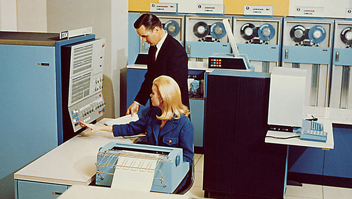
The 1957 film Desk Set captured a very real 1950s anxiety — that a new computer would make office workers obsolete. That fear wasn't unfounded: the 1960s did bring the first large-scale rollout of mainframes into payroll, insurance, and government recordkeeping, all labour-intensive work. But the disruption played out over a generation, not overnight, and it created new categories of work — systems programmers, data analysts, and eventually a whole software industry — alongside the jobs it displaced.
It's worth remembering how alien those machines felt at the time, taking up an entire air-conditioned room, run by a small group of specialists. Marketing materials of the era actually used the word "technophobia" to describe how customers felt about them. Sound familiar?
By the 1970s and 1980s mainframes had faded into the background. They became mere infrastructure that bank tellers and airline agents used without a second thought — like the plumbing behind the walls.
We want to be careful not to oversell the parallel. AI-driven job loss will be real in certain sectors, and pretending otherwise would be dishonest. New technology reliably brings dislocation alongside growth — that's the pattern, not an exception to it. And let’s remember: technology doesn't hand us more free time, either. Computers were supposed to usher in a three day work week, and we all know how things turned out once cell phones arrived.
We remain long-term optimists about human adaptability, while recognizing markets never move in a straight line. They are lumpy and choppy in the short term, but smoother over the long term. Be prudent with what you need sooner: stay liquid for short-term needs, manage your spending, and most importantly, stay optimistic about how human ingenuity compounds over decades — it's a force we consistently underestimate.
Randy, Ian, and Harrison
If this was useful to you, the best compliment is passing it along to someone who'd find it interesting.
This report is provided for informational purposes only and does not constitute an offer or solicitation to buy or sell any securities discussed herein in any jurisdiction where such offer or solicitation would be prohibited.