



Andrew Pittet
April 09, 2026



All about oil
"We aren’t addicted to oil, but our cars are." James Woolsey, former CIA Director
Oil has dominated headlines recently and I was also reminded of its impact when I filled up my truck’s gas tank for the first time since late February (it cost $72.08 more than last time!)
The main driver behind this price surge is geopolitics. The Strait of Hormuz, a critical waterway south of Iran, has been closed due to military conflict. About 102 million barrels of oil are used worldwide each day, and one-fifth of that travels through this passage.1 With commercial tankers blocked, global supply has dropped.
Economics tells us that prices are set by supply and demand. With 20 million barrels per day removed from the market, prices have climbed to find a new balance. While this supply shock is significant, its impact on prices has actually been less dramatic than some recent demand shocks. For example, during the peak of COVID lockdowns in spring 2020, demand fell by nearly 30 million barrels per day as airplanes stopped flying and drivers stopped commuting.2 Oil prices dropped sharply and briefly touched -$37.63 per barrel, as traders actually paid buyers to avoid storage limitations.
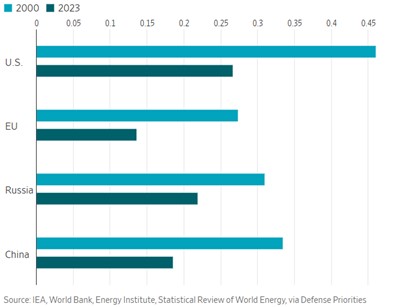
Despite oil’s ongoing importance to the global economy, another long-term trend having an impact behind the headlines is the steady shift toward reduced oil intensity. The chart below from The Wall Street Journal shows how much oil is needed to generate $1,000 of GDP. Today, the world uses about half as much oil for the same economic activity as it did two decades ago. There are a couple of reasons for this trend. Improved fuel efficiency is one, with the average fuel economy for US vehicles rising from 13.1 to 27.1 miles per gallon since 1975.3 Another factor is the shift toward a service-based economy (Things like yoga studios use less oil than a manufacturing plant…)
Oil intensity, measured as barrels consumed per $1,000 of GDP4
In my view, although the recent oil price activity has been significant, the market seems skeptical about the likelihood of a long-term closure of the Strait of Hormuz. This caution seems to be a continuation of the “TACO” trade (Trump Always Chickens Out), a term coined during the rapid shifts in US policy observed in past tariff negotiations.
Stay disciplined,
-Andrew
Sources: 1) International Energy Agency 2) Canadian Energy Regulator 3) Environmental Protection Agency 4) The Wall Street Journal
CIBC Private Wealth consists of services provided by CIBC and certain of its subsidiaries, including CIBC Wood Gundy, a division of CIBC World Markets Inc. The CIBC logo and “CIBC Private Wealth” are trademarks of CIBC, used under license. “Wood Gundy” is a registered trademark of CIBC World Markets Inc.
This information, including any opinion, is based on various sources believed to be reliable, but its accuracy cannot be guaranteed and is subject to change.
Andrew Pittet is an Investment Advisor with CIBC Wood Gundy in Calgary. The views of Andrew Pittet do not necessarily reflect those of CIBC World Markets Inc.
If you are currently a CIBC Wood Gundy client, please contact your Investment Advisor.
Related posts
Andrew Pittet
May 29, 2025
Shift Happens
Global trade has shifted from the US to China - but overall trade has grown and investors are better off for it
Read moreAndrew Pittet
November 13, 2025
Gold rush
Gold’s recent surge highlights its enduring appeal as a safe-haven asset, but over the long term, productive investments like stocks have delivered far greater returns.
Read more