



Bram Houghton
October 13, 2026
Economy Commentary Monthly update Monthly commentary


Market Update - October 2026
MARKET UPDATE – September 7th – October 9th 2026
In a Nutshell: S&P 500 hit an all time high this week despite a choppy start to October as bond yields took centre stage, with the 10 year Treasury Bill hitting its highest level since 2002. Despite this, corporate earnings and equity markets have remained resilient, with North American markets posting solid returns for September. Europe saw a different story with sticky inflation putting a dent in monetary easing plans.
Trade News
In retaliation against earlier U.S. measures, Canada officially enacted reciprocal counter-tariffs on approximately $27.6 billion of U.S. products on September 8, 2026, targeting steel, appliances, agricultural machinery, dairy, and electronics, with the White House countering a week later. Escalation peaked late September when the U.S. enacted a direct import ban on nearly $1 billion of select Canadian goods, specifically cutting off imports of Canadian beer, wine, spirits, among others. This week, U.S. Trade Representative officials confirmed Washington is holding fast on its aggressive tariff stance, while existing combined duties on Canadian softwood lumber continue to surpass 45%.
Outlook: The compounding rounds of punitive tariffs and product bans are projected by economists to shave between 0.4% and 0.5% off Canadian real GDP growth1, with manufacturing hubs across Ontario, Quebec, and British Columbia bearing the brunt of the shock; without a formal bilateral de-escalation corridor before annual CUSMA reviews, elevated input costs and supply-chain re-routing will depress North American trade volumes through the fourth quarter.
1Estimated Tariff impact range include sources such as Deloitte, TD Economics, RBC Economics and BNN Bloomberg
Middle Eastern Conflict
Diplomatic maneuvering over the past month centered around the 81st United Nations General Assembly in late September, where international mediators sought to formalize terms following the expiration of the Islamabad Memorandum of Understanding. Preconditions for permanent de-escalation were discussed at length, with Tehran insisting on sanctions relief and reciprocity. Persistent maritime standoffs and localized drone skirmishes in the Gulf have prevented a complete return to normalized commercial transit through the critical Strait of Hormuz.
Outlook: The lack of an enforceable verification mechanism in the Board of Peace framework leaves regional truces deeply unstable; unless mediators can secure binding guarantees regarding maritime security and border demilitarization, flashpoint incidents along transit corridors threaten to dismantle temporary arrangements and trigger another wave of energy market disruption2.
2Outlook statement sourced from the following link
U.S. Labour Markets
The U.S. labor market cooled substantially over the last four weeks as hiring slowed to a crawl. The Bureau of Labor Statistics reported that nonfarm payrolls added just 29,000 jobs in September 2026, falling dramatically below consensus forecasts of 90,000. This deceleration was compounded by sharp downward revisions: August payrolls were revised down by 29,000 to 133,000, reducing the three-month average payroll gain to 51,000 jobs per month. However, layoffs remain subdued, as initial jobless claims fell to 197,000 for the week ending October 3, pulling the 4-week moving average down to 198,000, while annual nominal wage growth moderated to 3.0% year-over-year.
Outlook: The labor market has locked into a definitive "low-hiring, low-firing" regime; while sub-200,000 initial claims indicate that mass job shedding remains absent, wage growth moderating to 3.0% alongside anemic job creation leaves consumer spending power increasingly fragile against sticky goods inflation.
U.S. Economy
Second-quarter output demonstrated resilient underlying momentum, even as persistent price pressures prompted additional monetary tightening. The third estimate for Q2 2026 confirmed real GDP expanded at an annualized rate of 2.2% (a 0.7-percentage-point upgrade from earlier readings), supported by a surge in real final sales to private domestic purchasers and robust data center and AI infrastructure construction. On the inflation front, the August CPI report posted headline CPI at 3.4% year-over-year, though street consensus expects headline CPI to bounce to 3.6%–3.7% in the upcoming September report due to record fuel costs. Faced with sticky price metrics, the Federal Reserve delivered a 25-basis-point interest rate hike on September 16, 2026, lifting the policy rate to 3.75%–4.00%. Industrial activity remained positive with the ISM Manufacturing PMI printing at 54.5 in September, though its Prices Index surged 6.8 points to 77.9 on tariff and energy impacts.
Outlook: With private domestic demand expanding at 4.6% and factory input costs climbing toward multi-year peaks, the Fed’s September rate hike to 3.75%–4.00% signals that monetary policy will likely remain restrictive through early 2027, steadily increasing the cost of capital and putting a ceiling on interest-sensitive business investment.
Canadian Economy
Canada’s economic trajectory downshifted meaningfully as earlier momentum gave way to labor softness and trade headwinds. Monthly GDP stalled at 0.0% in July, positioning third-quarter annualized output to cool to roughly 1.8% following the second quarter's rebound. Headline CPI held steady at 3.0% in August, where softening grocery inflation and lower pump prices were counterbalanced by persistent shelter costs. Industrial activity showed signs of strain as the Manufacturing PMI slipped to 51.5 in September, marking its weakest expansion since March. Compounding headwinds, the Labour Force Survey revealed a surprise contraction in September employment, reinforcing market expectations for the Bank of Canada to hold its benchmark rate at 2.25%.
Outlook: Canada's economy enters the fourth quarter on fragile footing as the temporary boost from exports brought forward ahead of tariffs fades, while the labour market cools, factory orders soften and softening factory orders. With headline inflation capped at 3.0%, the Bank of Canada is expected to maintain a prolonged hold on its 2.25% policy rate through year-end to safeguard domestic demand against escalating cross-border trade duties.
Eurozone and UK Economy
In Europe, economic expansion reached a multi-year high, with the Composite PMI rising to 53.1 in September (up from 52.0 in August), driven by the Manufacturing PMI surging to 52.9, the strongest level since May 2022. However, price stability deteriorated rapidly; Eurostat’s flash estimate revealed headline annual inflation jumped to 3.8% in September (up from 3.2% in August), fueled by steep increases in energy tariffs and persistent services charges.
The UK economy maintained steady growth, with monthly real GDP expanding 0.4% in July 2026. Inflation metrics mirrored the continent's upward trend, as the headline Consumer Prices Index rose to 3.1% year-over-year in August (up from 2.9% in July), pushed higher by regulated household utility cap adjustments and transport costs.
Outlook: While robust manufacturing and services PMIs indicate resilient output across both economies, headline inflation climbing back above 3.0% in the UK and reaching 3.8% in the Eurozone will likely halt any near-term monetary easing by the Bank of England and European Central Bank, heightening stagflation risks as higher winter utility bills weigh on household disposable income.
Commodities
Global commodity complexes experienced sharp price divergences over the last four weeks as energy supply risks escalated. Geopolitical tensions and maritime friction in the Middle East drove a sharp rally in crude oil, with Brent crude surging and WTI crude climbing above $90 per barrel (reversing August's brief dip into the low $80s). In U.S. reserves, crude oil inventories fell by 3.19 million barrels, following mixed weekly adjustments in late September. Conversely, domestic natural gas buffers expanded steadily, standing roughly 2.4% above the five-year seasonal average. In precious metals, gold consolidated off record highs following global central bank rate moves, with COMEX gold futures trading in a band between $4,156 and $4,204 per ounce to settle near $4,185 per ounce.
Outlook: Crude oil is expected to remain firm in the $95–$105 per barrel range through early winter due to low commercial inventories and volatile Middle Eastern transit risk; natural gas should remain well-supplied within North America as storage figures remain resilient, though global LNG supply deficits will likely keep international export prices elevated. Meanwhile, gold remains technically supported near $4,150–$4,200 per ounce, with persistent sovereign reserve accumulation and trade war hedging counterbalancing higher global interest rates.
Latest Equity Market Data

Reuters Market Updates http://www.reuters.com
Bloomberg Market Updates - https://www.bnnbloomberg.ca/markets
Understanding the 10-Year Treasury: A Multifactor Framework by Cole Smead, CEO, Portfolio Manager, Smead Capital Management Link to article
The recent rise in the 10-year U.S. Treasury yield appears to reflect a combination of forces rather than any single issue such as tariffs or government spending. While headlines often focus on one explanation, the broader story is that rates are moving back toward more normal historical levels after an unusually long period of very low yields. Persistent deficits, trade uncertainty, and shifting investor sentiment are all part of the picture, but none fully explain the move on their own.
U.S. Treasury rate from 1962 to present
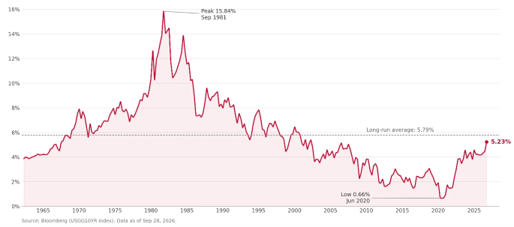
A key observation of rising yields is that capital now has more competition. Traditional buyers of government debt have been less aggressive, foreign ownership patterns have shifted with geopolitics, and large technology companies are using enormous amounts of capital to fund AI and data center expansion rather than parking cash in safe government securities. In that environment, U.S. Treasuries may need to offer higher yields to attract investors.
Outlook: The key takeaway is that higher rates are not just a policy story — they also reflect a changing global capital market where government debt is competing with other high-quality opportunities for investor dollars.
Market Ethos: Hot in Herre by Craig Basinger, Chief Investment Strategist, Purpose Investments Link to Article
Despite a sharp rise in U.S. Treasury yields, markets have remained relatively resilient because investors appear to be interpreting higher rates as a sign of stronger economic growth rather than a warning signal. Recent data points to solid consumer spending, continued business investment, and improving earnings, which has helped support equity markets even as borrowing costs move higher. In that context, rising yields are being seen as a reflection of economic momentum, not simply inflation or market stress.
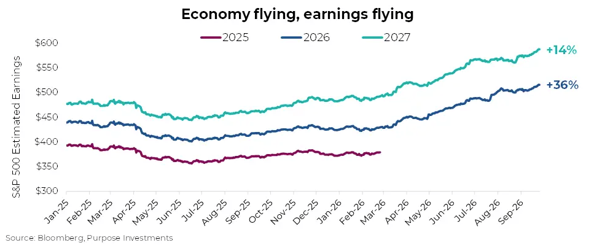
That said, higher yields are still creating challenges. Interest-sensitive areas such as housing are feeling pressure, and the usual diversification benefit between stocks and bonds has been less effective as both have been influenced by stronger growth and rising rate expectations.
Despite this, there are still diversification opportunities within equities, as stock performance has been more varied quite substantially, which has reduced the extent at which stock prices move in unison. This means there is still opportunities to find both value and diversification within equity markets.
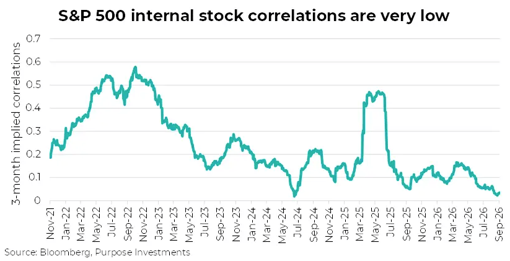
Outlook: Overall, the backdrop remains constructive, but there is likely a limit to how far yields can rise before they become a more meaningful headwind for investors.
Macro Memo - October 6 – November 2, 2026 by E.Lascelles, J.Nye Link to Article
Higher yields bite but boost return potential
Rising government bond yields are creating a more challenging environment for investors, as higher interest rates and persistent inflation put pressure on the valuations of both bonds and equities. While the S&P 500 remains near its highs, much of that strength has been driven by a small group of large technology companies, with the average stock showing more signs of strain. In today’s market, higher yields are once again acting as a headwind for equity valuations, especially for areas that are more sensitive to borrowing costs and inflation.
Since late 2025, S&P 500 forward P/E dropped as 10-year bond yields rose
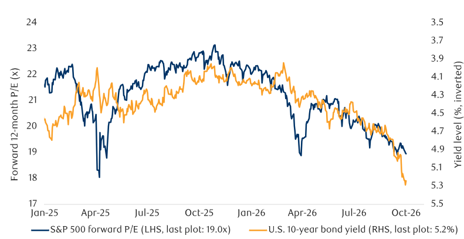
As of 10/01/2026. Sources: Bloomberg, RBC GAM
At the same time, higher yields are also improving future return potential, particularly in fixed income. Historically, once bond selloffs come to an end, forward bond returns have often been stronger because investors are starting from a higher income base. For equities, the outlook is more mixed and will depend on whether inflation begins to ease without causing a broader economic slowdown. For clients, the key takeaway is that higher yields may continue to create near-term volatility, but they are also resetting the opportunity set and making bonds more attractive than they have been in years.
U.S. and China Summit
The recent U.S.-China summit produced only modest progress, but it did help reduce the risk of an immediate escalation in trade tensions. The most meaningful outcome was a two-month extension of the current tariff truce, delaying a sharp increase in tariffs until January 2027. Both countries also signaled some goodwill by agreeing in principle to lower tariffs on a limited group of goods, although the scope, timing, and exact reductions have not yet been clarified.
That said, the broader trade relationship remains unresolved. The main tariff dispute has been postponed rather than settled, and some commitments, including China’s planned purchases of U.S. coal, should be viewed with caution given concerns about follow-through.
Outlook: The key takeaway is that the meeting offers some short-term stability, but U.S.-China trade tensions remain an ongoing source of uncertainty heading into 2027.
Canada’s corporate tax cut
Canada’s new Productivity Mega Deduction is a meaningful pro-business policy change that should improve the country’s appeal for investment. By allowing immediate expensing for a much larger share of capital spending, the measure improves corporate cash flow, lowers the effective tax cost of new investment, and makes Canada more competitive relative to the U.S. and other G7 countries. While there are different ways to measure tax competitiveness, the direction of change is clearly positive and represents a significant improvement in Canada’s investment backdrop.
Canada has lowest marginal effective tax rate in the G7
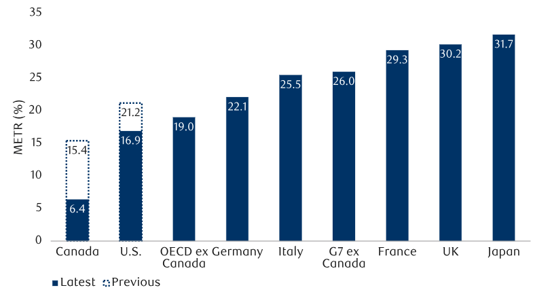
As at 09/15/2026. The marginal effective tax rate (METR) is the tax imposed on an additional dollar of business investment U.S. tax cut reflects OBBBA . Canada tax cut reflects Budget 2025, Spring Economic Update 2026 and recent Productivity Mega Deduction announcements. Sources: Government of Canada, RBC GAM
The broader significance is that this tax change is arriving alongside other supportive developments, including rising foreign direct investment, a more business-friendly regulatory tone, and progress on major energy and infrastructure projects. If businesses respond by increasing capital spending, the policy could help lift productivity and support stronger long-term economic growth.
Outlook: Canada’s policy environment appears to be becoming more supportive of investment, which could strengthen the country’s growth outlook over time.
If you think others may benefit from reading our content, please don’t hesitate to share it with them.
Aurie Wicks, CA, CPA, CFP® Wealth Advisor, (403) 835 - 4785, aurie.wicks@cibc.com
Tyler Quinn, CIM®, FCSI Sr. Investment Advisor, Portfolio Manager, (403) 299 - 7356, tyler.quinn@cibc.com
Bram Houghton, CFA, CFP® Associate Portfolio Manager, Wealth Advisor, (403) 690 - 9376, bram.houghton@cibc.com
Wicks Advisory Group are Investment Advisors with CIBC Wood Gundy in Calgary, Alberta, Canada. The views of Wicks Advisory Group and external commentary [KF1] do not necessarily reflect those of CIBC World Markets Inc.
CIBC Private Wealth consists of services provided by CIBC and certain of its subsidiaries, including CIBC Wood Gundy, a division of CIBC World Markets Inc. "CIBC Private Wealth" is a registered trademark of CIBC, used under license. "Wood Gundy" is a registered trademark of CIBC World Markets Inc.
If you are currently a CIBC Wood Gundy client, please contact your Investment Advisor.
This information, including any opinion, is based on various sources believed to be reliable, but its accuracy cannot be guaranteed and is subject to change. CIBC and CIBC World Markets Inc., their affiliates, directors, officers and employees may buy, sell, or hold a position in securities of a company mentioned herein, its affiliates or subsidiaries, and may also perform financial advisory services, investment banking or other services for, or have lending or other credit relationships with the same. CIBC World Markets Inc. and its representatives will receive sales commissions and/or a spread between bid and ask prices if you purchase, sell or hold the securities referred to above. © CIBC World Markets Inc. 2026.
The enclosed research report(s) from FINRA dealers or other CIRO-recognized foreign regulators are not prepared subject to Canadian disclosure requirements under CIRO Rules.
The commentary is for informational purposes only and is not being provided in the context of an offering of any security, sector, or financial instrument, and is not a recommendation or solicitation to buy, hold or sell any security.
Clients are advised to seek advice regarding their particular circumstances from their personal tax and legal advisors.
Related posts
Bram Houghton
August 10, 2026
Market Update - August 2026
Highlighting the key aspects of what we have seen in global markets and the economy over the last month..
Read moreBram Houghton
July 06, 2026
Market Update - July 2026
Highlighting the key aspects of what we have seen in global markets and the economy over the last two weeks.
Read more