




September 10, 2026



September 2026 Market Update
Market Update Septemeber 2026
As we move into fall and the final months of 2026 I thought it would be useful review the themes and issues that have shaped the markets recently, and what we see coming in the months ahead out to year end.
By far the single biggest issue the markets have been focusing on over the last month is US deficit spending and increases to long term interest rates, most notably, the US 10 year Treasury yield near 4.8%, a level not seen since January 2025 when it briefly hit 4.81% intraday before falling back. While the headlines seen alarming, and without a doubt this is a serious issue that all governments around the world will have to eventually address, these moves have been orderly and somewhat expected, given higher inflation and growth rates, both of which are constituents that contribute to the 10 Year Treasury yield.
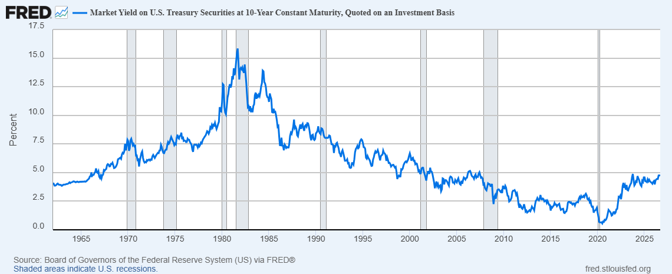
The chart above shows the long term trend of the US10 year Treasury yield, and as you can see, rates are normalizing after a long period of decline starting after the great financial crisis, engineering by the US government, and are now back to levels we saw in the 2000s, and still lower than they were 30 years ago. In fact, thirty years ago US debt to GDP was about 60%, about half of what it is today and yet interest rates are lower, growth is still positive and the US dollar, adjusted for inflation, is valued at about where it was back then, and remains the reserve currency to the world. It’s also worth noting that debt to GDP and long rates have been rising in all developed world countries, not just the US. The IMF estimates the following debt to GDP levels for the major G7 countries: Japan 204%, Italy 138%, USA 125%, France 118%, Canada 110%, UK 104%, Germany 65%.
The other topic making the rounds on Wall Street is the new Fed Chair Kevin Warsh, an advocate for less communication and forward guidance than his predecessor Jerome Powell, which the market will take time to adjust to. His recent comments at Jackson Hole struck a hawkish tone, and prediction markets now give a 65% probability of quarter point rate hike on September 16th. In fact, the market is already pricing in at least one quarter point hike onto 2 year Treasury yields, so this will come as no uprise to the markets, and will not have much of an impact to the economy. Warsh’s job becomes much easier if there’s a resolution to the war in Iran and oil prices decline. Core inflation ex food and energy is running at around 2.5%, close to the Fed’s target of 2%. However, the longer the conflict and higher oil prices persist, the more of an impact we will see in all parts of the economy as transportation and manufacturing costs rise and feed into finished goods prices.
It’s hard to see an obvious off ramp for the war in the Middle East. Iran seems willing to endure any pain the US miliary and US sanctions can impose, and both sides seem unwilling to negotiate a settlement which would allow the reopening of the Strait of Hormuz. Meanwhile the world is adjusting, with China no longer importing 3 million barrels per day to their strategic reserves, oil producers around the world are ramping up production, and some oil still moves through the Strait at night with transponders off, avoiding Iranian drone attacks.
New Trump tariffs continue to impact trade and Canadians recent suspension of trade negotiations with the US could have some modest impact on Canadian growth, with newly tariffed trade involving autos, parts, aluminum and steel impacting about 5% of our trade with the Americans. Estimates suggest a 0.5% impact on Canadian GDP, although the Carney government has expressed interest in resuming trade talks as Canada seeks new opportunities with other trading partners abroad. This effort will take time but ultimately has the potential of diversify our trade relationships which for too long has depended on America.
In spite of these concerns it’s quite remarkable to see how resilient the US and Canada stock markets have been throughout the year. Equity market indexes are all up double digits. Corporate year over year earnings growth is over 20% in the US and 15% in Canada, led by technology, financials, energy (higher oil prices) and industrials. Expectations for earnings estimates for 2027 are also higher, implying constructive equity markets again 2027. Valuations, while somewhat elevated in some sectors, are not excessive, and certainly nowhere near the levels experienced prior to the tech bubble in 2000.
Continued discussion about a market bubble has persisted for several years now, with nothing to show for all the buzz. Tom Bradley, a former Canadian equity analyst and portfolio manager with PH&N, now running money at Purpose Investments, recently commented on this in the Globe and Mail on August 29, 2026. He noted we won’t know if there’s an AI or private equity or private credit bubble until after it bursts. But there are several things that need to happen before such bubbles deflate. Firstly, prices have to rise rapidly to unforeseen heights, people are very confident about what’s going to happen, and stocks are good to own at any price as math goes out the window. We have seen some of this behaviour in some AI related names but it has been limited in scope. Secondly, the media eventually kicks in as cheerleaders and stock market enthusiasm is no longer restricted to business news, FOMO is the order of the day (fear of missing out) as those who have missed out on early gains feel compelled to buy, keeping the trend going. Thirdly, late adopters are compelled to join the mania because of new investment products designed to capitalize on the trend.
As an Investment Advisor with CIBC Wood Gundy in the late 1990’s this all sounds very familiar to me. I also know that far more bubbles are predicted than actually occur. Only time will tell if we are currently in the midst an AI bubble, although my personal view is that we could be in the early stages of what might become a bubble in the years to come. But investor sentiment right now is very cautious, the media bears are out in full force pointing out everything that could go wrong, some of the best growth stocks leading the AI advance are trading at multiples lower than slow growing consumer staple stocks, and some consumers are feeling the pinch of higher prices making them less than enthusiastic about investing any discretionary income in the stock market. This doesn’t feel remotely like what I experienced in the late 1990’s which is why I remain constructive on high quality large cap equities in Canada and the US.
Nick Colas, former hedge fund analyst, 40 year Wall Street veteran and founder of DataTrek Research, recently laid out his expectations for the markets for the next 12 months. His base case is for a 6% to 16% upside for the S&P500, based on strong corporate earnings growth, and market index multiples remaining constant at about 20 times forward earnings estimates. If we see a resolution to the US/Iran conflict and oil prices fall he thinks there could be additional upside as multiples rise with declining uncertainty.
Meanwhile, the Canadian market, dealing with new US trade tariffs, could see headwinds to earnings growth, but continuing high oil prices will support earnings, our commodities based market tends to benefit from inflationary periods such as we seeing now, and our banks have seen record growth over the last several years and while it’s unlikely they can continue their record growth rates, they remain core holdings for modest growth as long as capital markets remain constructive.
As always, if you would like to discuss any of the material, or if you would like to review your current portfolio, please do not hesitate to contact me or any member of my team and we can arrange an in-person meeting, Teams video conference call, or a telephone call to discuss your investments.
Best regards,

Gordon Forsey | Portfolio Manager, Senior Wealth Advisor | CIBC Private Wealth
1801-1969 Upper Water St., Halifax NS B3J 3R7 | Tel: 902-420-6203 | Toll Free: 1-800-565-0601
Email: gordon.forsey@cibc.ca
www.cibcwg.com/gordon-forsey


Gordon Forsey Advisory Group:
Gordon Forsey P.Eng., MBA, CIM, FCSI
Portfolio Manager, Sr. Wealth Advisor
gordon.forsey@cibc.ca
Tel: 902-420-6203
Michael Forsey BA
Associate Investment Advisor
Michael.Forsey1@cibc.com
Tel: 902-420-8232
Terri MacPhail
Client Associate
terri.macphail@cibc.ca
Tel: 902-420-8263
Elizabeth Haggar BSc
Client Associate
Elizabethann.haggar@cibc.com
Tel: 902-420-8234
CIBC Private Wealth consists of services provided by CIBC and certain of its subsidiaries, including CIBC Wood Gundy, a division of CIBC World Markets Inc. The CIBC logo and “CIBC Private Wealth” are trademarks of CIBC, used under license. “Wood Gundy” is a registered trademark of CIBC World Markets Inc.This information, including any opinion, is based on various sources believed to be reliable, but its accuracy cannot be guaranteed and is subject to change.
This commentary is for informational purposes only and is not being provided in the context of an offering of any security, sector, or financial instrument, and is not a recommendation or solicitation to buy, hold or sell any security.
These calculations and projections are for demonstration purposes only. They are based on several assumptions and consequently actual results may differ, possibly to a material degree. If you are currently a CIBC Wood Gundy client, please contact your Investment Advisor.
™Trademark of CIBC World Markets Inc. CIBC Wood Gundy will be responsible to CIBC Wood Gundy Investment Consulting Service clients for the advice provided by any Investment Manager. This material comes from the computer calculations of Gordon Forsey. In the event of a discrepancy between the data used in this report and the data generated by CIBC Wood Gundy, reliance must be placed on the data generated through the facilities of CIBC Wood Gundy. Yields/rates are as of the above date and are subject to availability and change without notification. Minimum investment amounts may apply. Insurance services are available through CIBC Wood Gundy Financial Services Inc. In Quebec, insurance services are available through CIBC Wood Gundy Financial Services (Quebec) Inc. Clients are advised to seek advice regarding their particular circumstances from their personal tax and legal advisors. CIBC Wood Gundy is a division of CIBC World Markets Inc
Clients are advised to seek advice regarding their particular circumstances from their personal tax and legal advisors.