




Milan Cacic
March 06, 2026
Money Economy Commentary In the news News Trending Weekly update Weekly commentary


THE STRAIT OF HORMUZ: 21 MILES THAT MATTER
We’ve received a few calls over the past week asking about the war involving Iran and how it might affect markets. The reason it matters comes down to one place: the Strait of Hormuz.
Most people couldn’t find it on a map. But right now, this narrow passageway is influencing the price of nearly everything. The Strait of Hormuz sits between Iran and Oman and carries roughly 20% of the world’s oil and about 23% of global natural gas every single day. There is no meaningful alternative route. Ship traffic through the area is already down roughly 70%, war-risk insurance has surged several times over in just a weekend, Qatar has halted LNG production, and European natural gas prices are already up roughly 50%.
In the United States, gasoline prices are expected to rise 25-50 cents per gallon in the near term. Higher gas prices act like a tax on consumers – money spent at the pump is money not spent elsewhere. Not ideal timing for households already dealing with two years of elevated prices.
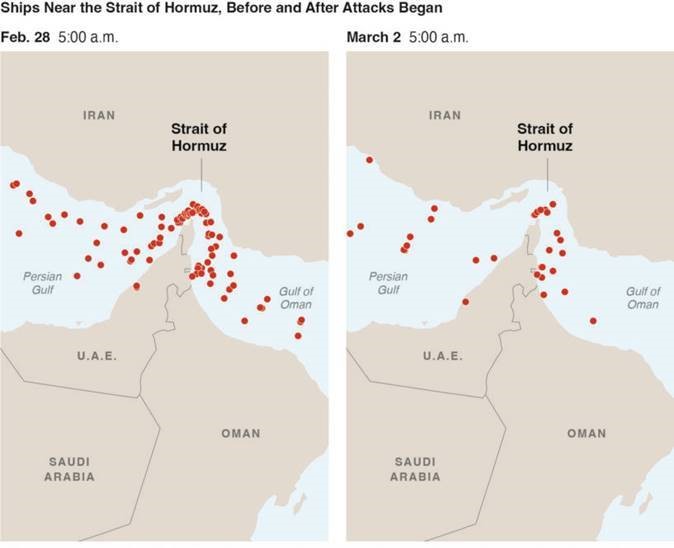
Note: Times shown are in Iran Standard Time. Some ships in the region transmit false positions and others sometimes stop broadcasting their locations. As such, some may not be reflected on the maps. Locations are approximate. Source: Kpler, The New York Times
The China wrinkle
About 80% of Iran’s oil exports go to China, historically at a steep discount. That discount has now disappeared. China must source more oil from global markets at full price – adding demand pressure to an already tight supply picture, while higher energy costs also weigh on its own economy.
The key question now is duration
Markets have historically been very good at shrugging off Middle East conflict. In fact, oil prices were actually lower last Friday than they were before the current conflict began in October 2023. But a prolonged disruption at the Strait of Hormuz is a different story. The longer it lasts, the more inflation pressure builds, the higher energy prices climb, and the harder it becomes for central banks to cut interest rates.
I have also included a piece from our CIBC Economics team entitled “War, oil and inflation: Thumbing through some rules of thumb” .
As always, if you have any questions, please feel free to give us a call at any time.
Have a great weekend.
Milan