


Skip to Main Content
  • CIBC.com
  • CIBC Private Wealth
  • CIBC Websites
Client Login
  • Home
  • Our Team
  • Commentary
    • Blog
    • Video
    • Market insights
  • Services
    • Our solutions
    • Advisor Managed Account
    • Community
  • Commonly asked questions
  • Contact us
  • CIBC.com
  • CIBC Private Wealth
  • CIBC Websites
  • Client Login
 CIBC Private Wealth, Wood Gundy  CIBC Private Wealth, Wood Gundy

Cacic Wealth Management

  • Home
  • Our Team
  • Commentary
    • Blog
    • Video
    • Market insights
  • Services
    • Our solutions
    • Advisor Managed Account
    • Community
  • Commonly asked questions
  • Contact us

Blog

Address 500 Centre Street SE 27th Floor Calgary AB, T2G 1A6
Telephone Number (403) 508-3230
Email Email us
Email Email
Telephone Number Tel

MILAN CACIC

August 21, 2026

Money Economy Commentary Trending Weekly update Weekly commentary


Facebook
LinkedIn
Twitter

ARE WE ABOUT TO MISS THE BOAT AGAIN?

This week, Alberta regulators rejected a proposed data centre power project near Olds. The decision may have been justified, the proposed facility was extremely close to the community, but it also highlights a larger concern: Are AI data centres about to run the same Canadian gauntlet as LNG?

Fifteen years ago, Canada had more than 30 LNG export applications. While we spent years debating, permitting, and delaying, the United States and Australia built facilities and became global LNG leaders. Canada’s first large export terminal only began operating in 2025, nearly a decade after the first major U.S. facility. Today, the United States is the world’s largest LNG exporter.
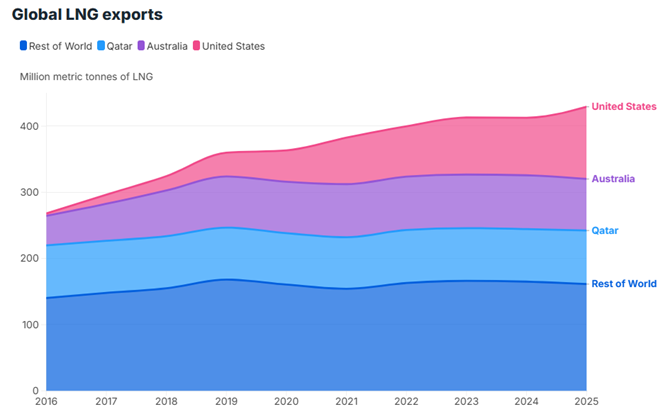
Stacked area chart titled “Global LNG exports” showing LNG exports from 2016 to 2025 in million metric tonnes, broken into Rest of World, Qatar, Australia, and United States. Total exports rise steadily from roughly 270 million metric tonnes in 2016 to about 430 million metric tonnes in 2025. Rest of World is the largest component throughout, increasing modestly overall with slight dips around 2020–2021. Qatar remains relatively stable near 80 to 90 million metric tonnes. Australia grows through 2019, then levels off around the low 80s before ending slightly lower by 2025. The United States shows the fastest growth, rising from a very small share in 2016 to a major contributor by 2025.

Source: Institute for Energy Economics and Financial Analysis, Kpler. Data as of Aug 20, 2026

Over that same decade, Canadian real GDP per person barely moved, while the United States, and, to a lesser extent, Australia pulled ahead. LNG was certainly not the only reason, but their willingness to build large, productive infrastructure contributed investment, exports, and economic activity that Canada largely missed.
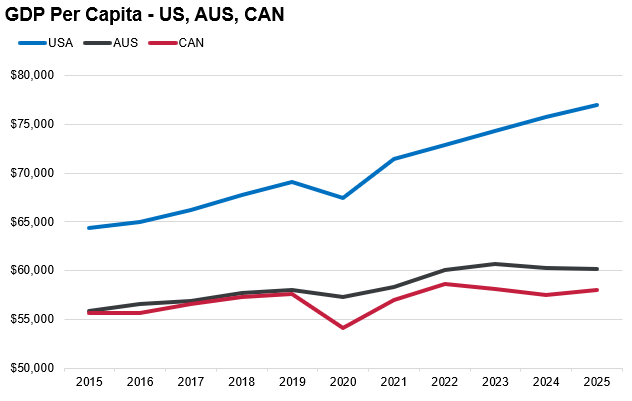
Line chart titled “GDP Per Capita - US, AUS, CAN” comparing the USA, Australia, and Canada from 2015 to 2025. The USA line is highest throughout, rising from about $64,000 in 2015 to about $77,000 in 2025, with a dip in 2020 before climbing sharply. Australia stays in the middle, increasing gradually from about $56,000 to $60,000, peaking slightly above $60,000 around 2023. Canada is lowest overall, starting near $55,500, dropping sharply to about $54,000 in 2020, then recovering to just under $58,000 by 2025. Y-axis ranges from $50,000 to $80,000.

Source: Institute for Energy Economics and Financial Analysis, Kpler. Data as of Aug 20, 2026

Data centres have legitimate drawbacks. They consume enormous amounts of power, can affect water supply, and create fewer permanent jobs than their construction cost might suggest. But they also attract billions of dollars, create demand for Canadian electricity and natural gas, strengthen local infrastructure, and place Canada inside one of the most important economic buildouts of our lifetime. Meta’s recently announced Alberta project represents more than $13 billion of investment alone.

Canada does not need to approve every project. But if every major project faces years of uncertainty and opposition, capital will do what it did during the LNG boom: build somewhere else.

Canada doesn’t need to say yes to everything, but “not here” cannot remain our industrial strategy.

I have also included a piece from our CIBC Economics team entitled “Will the Midterms matter?”.

As always, if you have any questions, please feel free to give us a call at any time.

Have a great weekend.

Milan

Related posts

MILAN CACIC

August 14, 2026

A.I. IS GROWING UP!

Read more

Milan Cacic

August 07, 2026

WHEN DOES DEBT BECOME A PROBLEM?

Read more
 
 
  • Rates
  • FAQ
  • Agreements
  • Trademarks & Disclaimers
  • Privacy & Security
  • CIRO AdvisorReport
  • Accessibility at CIBC
  • Manage Cookie Preferences
  • Cookie Policy
 Canadian Investment Regulatory Organization  Canadian Investor Protection Fund

CIBC Private Wealth” consists of services provided by CIBC and certain of its subsidiaries through CIBC Private Banking; CIBC Private Investment Counsel, a division of CIBC Asset Management Inc. (“CAM”); CIBC Trust Corporation; and CIBC Wood Gundy, a division of CIBC World Markets Inc. (“WMI”). CIBC Private Banking provides solutions from CIBC Investor Services Inc. (“ISI”), CAM and credit products. CIBC Private Wealth services are available to qualified individuals. Insurance services are only available through CIBC Wood Gundy Financial Services Inc. In Quebec, insurance services are only available through CIBC Wood Gundy Financial Services (Quebec) Inc.


CIBC Private Wealth services are available to qualified individuals. The CIBC logo and “CIBC Private Wealth” are trademarks of CIBC, used under license.