


Skip to Main Content
  • CIBC.com
  • CIBC Private Wealth
  • CIBC Websites
Client Login
  • Home
  • Our Team
  • Commentary
    • Blog
    • Video
    • Market insights
  • Services
    • Our solutions
    • Advisor Managed Account
    • Community
  • Commonly asked questions
  • Contact us
  • CIBC.com
  • CIBC Private Wealth
  • CIBC Websites
  • Client Login
 CIBC Private Wealth, Wood Gundy  CIBC Private Wealth, Wood Gundy

Cacic Wealth Management

  • Home
  • Our Team
  • Commentary
    • Blog
    • Video
    • Market insights
  • Services
    • Our solutions
    • Advisor Managed Account
    • Community
  • Commonly asked questions
  • Contact us

Blog

Address 500 Centre Street SE 27th Floor Calgary AB, T2G 1A6
Telephone Number (403) 508-3230
Email Email us
Email Email
Telephone Number Tel

MILAN CACIC

October 02, 2026

Money Financial literacy Economy Commentary In the news News Trending Weekly update Weekly commentary


Facebook
LinkedIn
Twitter

AI’S NEXT BOTTLENECK ISN’T CHIPS, IT’S POWER


For the past few years, the AI race has largely been about chips. Who could get enough GPUs, who could build the biggest data centres, and who could spend the most money. But, increasingly, the most important question is becoming much simpler: where are we going to get all the electricity?

The numbers are enormous. The international Energy Agency expects global energy consumption from data centres to roughly double between 2025 and 20301. In the US, data centres could consume around 12% of all electricity by the end of the decade. After years of relatively stagnant electricity demand, AI is helping turn power into a growth industry again.
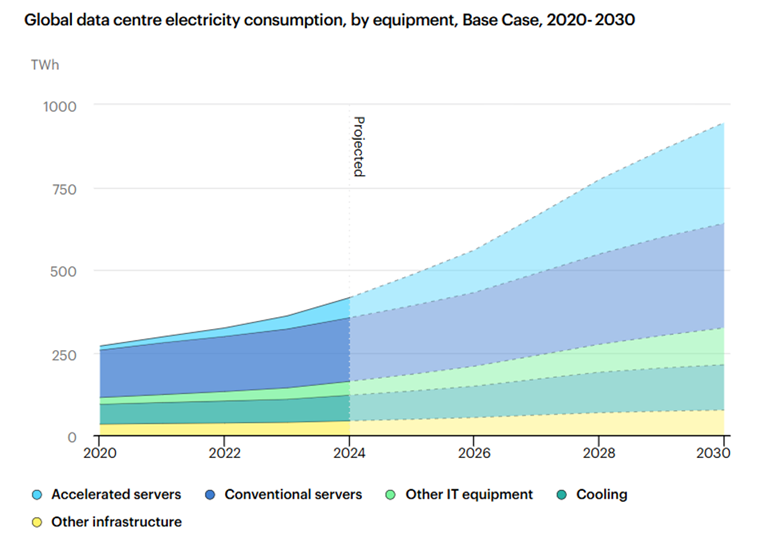
Stacked area chart titled “Global data centre electricity consumption, by equipment, Base Case, 2020–2030.” The y-axis shows electricity use in TWh from 0 to 1000, and the x-axis runs from 2020 to 2030, with a vertical marker at 2024 labeled “Projected.” Total data centre electricity consumption rises from just under 300 TWh in 2020 to nearly 950 TWh in 2030. Conventional servers make up the largest share throughout, while accelerated servers grow rapidly after 2024. Cooling, other IT equipment, and other infrastructure also increase steadily over time.

Source: IEA (2025), Energy and AI, IEA, Paris https://www.iea.org/reports/energy-and-ai, Licence: CC BY 4.0


And we are already starting to see the bottleneck. This week, regulators highlighted a projected 6,800-megawatt power shortfall in the PJM electricity market, which serves more than 65 million Americans. Some data centre developers are now installing their own natural gas turbines rather than waiting years for a grid connection. In other words, having the chips and the money isn’t much use if you can’t plug the building in.

This changes how we think about the AI investment story. The obvious winners have been semiconductor companies, but the next beneficiaries may increasingly be companies involved in power generation, natural gas, nuclear energy, electrical equipment, transmission, cooling, and the grid itself. AI is beginning to look as much like an industrial and energy build-out
as it is a technology boom.

It also creates an interesting opportunity for Canada. We have abundant natural gas, uranium, hydroelectricity, and other energy resources. Exactly the things that an increasingly power-hungry world needs. The opportunity is obvious. As we have written before, our challenge is generally not figuring out what we have; it’s figuring out how to actually build
something with it.

The AI boom isn’t slowing because we’ve run out of ideas. Increasingly, the constraint is much more old-fashioned.

The world’s most advanced technology may ultimately depend on something remarkably simple: finding somewhere to plug it in.

I have also included a piece from our CIBC Economics Team entitled “Earnings and economic growth: Mind the gap”.

As always, if you have any questions, please feel free to give us a call at any time.

Have a great weekend.

Milan

Related posts

MILAN CACIC

October 09, 2026

CANADA’S ADVANTAGE IS UNDER OUR FEET

Read more

Milan Cacic

September 25, 2026

THE 5% PROBLEM

Read more
<p><span style="font-size:10.0pt"><span style="font-family:&quot;Calibri&quot;,sans-serif">This commentary is for informational purposes only and is not being provided in the context of an offering of any security, sector, or financial instrument, and is not a recommendation, an endorsement,&nbsp; or solicitation to buy, hold or sell any security.</span></span></p>
 
 
  • Rates
  • FAQ
  • Agreements
  • Trademarks & Disclaimers
  • Privacy & Security
  • CIRO AdvisorReport
  • Accessibility at CIBC
  • Manage Digital Preferences
  • Digital Preferences Policy
 Canadian Investment Regulatory Organization  Canadian Investor Protection Fund

CIBC Private Wealth” consists of services provided by CIBC and certain of its subsidiaries through CIBC Private Banking; CIBC Private Investment Counsel, a division of CIBC Asset Management Inc. (“CAM”); CIBC Trust Corporation; and CIBC Wood Gundy, a division of CIBC World Markets Inc. (“WMI”). CIBC Private Banking provides solutions from CIBC Investor Services Inc. (“ISI”), CAM and credit products. CIBC Private Wealth services are available to qualified individuals. Insurance services are only available through CIBC Wood Gundy Financial Services Inc. In Quebec, insurance services are only available through CIBC Wood Gundy Financial Services (Quebec) Inc.


CIBC Private Wealth services are available to qualified individuals. The CIBC logo and “CIBC Private Wealth” are trademarks of CIBC, used under license.