







Black Monday 1987: A Great Reminder That Nothing Changes
On October 19, 1987, the U.S. stock market dropped 22.6% (as measured by the Dow Jones Industrial Average) in one day.
What did this mean? If you had $5 million invested in the market at breakfast, you very likely had less than $4 million by the end of the day. You were probably nervous and the media helped stoke that fear.
I (Randy), on the other hand, had $3,000 in a mutual fund, my only savings, but I didn’t find out that my account was down until sometime in mid-November when my statements arrived in the mail. I was 21 and in university. I didn’t have a cell phone, laptop, social media, 24-hour news, TikTok or Instagram — and neither did you.
A news report from that day very much mirrors the fears, hyperbolic language, and clickbait used today to glue people to “the news”:
The 1987 stock market crash: Original news report (please note that clicking the hyperlink will take you away from our webpage to YouTube)
The reasons given for the “crash” in 1987 sound like they could just as easily have been heard in early fall 2026 to explain today’s events:
- fears of higher interest rates
- national computer failure
- investors seeing the economy as glass half empty vs. glass half full
- renewed inflation fears/decline in the dollar
- huge budget deficit/ huge foreign trade deficit
- a nation living for too long beyond its means
Sam Walton, then America’s richest man, was unaware of the market crash and said he would take care of his company and the market could take care of itself. He was right and it did.
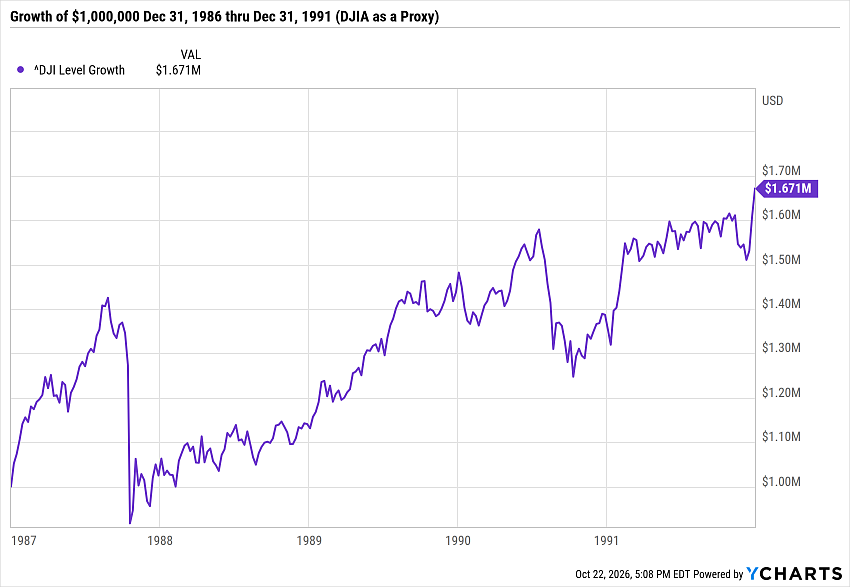
- The U.S. stock market still ended the year in positive territory.
- $1 million invested at the start of 1987 was worth $1.671 million five years later (December 31, 1991).*
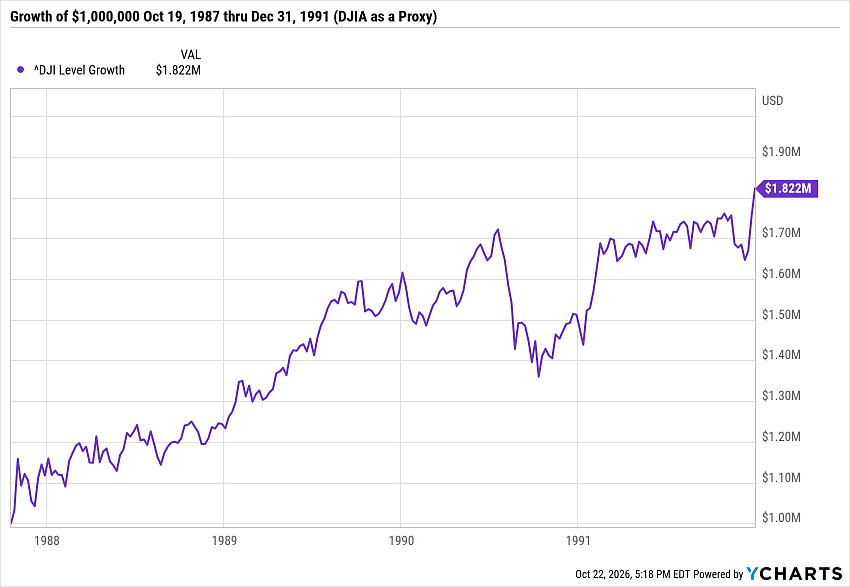
- Even better, the investor who ignored the news and invested the day of the broadcast saw their $1 million grow to $1.822 million by the end December 1991.*
Are we predicting a 22% market crash? No we’re not.
Yet, on the 39-year anniversary of this event, it is useful to re-examine how the “noise” wants nothing more than to get you to stray from your long-term plans in favour of the crisis of the day.
Whether it’s the dollar, the trade deficit, AI, the President, the pipeline, the weather, the oil embargo, or whatever else it turns out to be, long-term investors who do not get distracted continue to be rewarded.
Long-term investors also accept that markets do not go up in a straight line, so keeping bucket number one full to take care of your near-term cash needs just makes sense.
We thank you for your trust, and welcome any questions you may have.
Randy, Ian and Harrison
*All the hypothetical scenarios use Dow Jones Industrial Average Index levels as proxies to calculate the hypothetical portfolio’s growth. It does not reflect actual investor experience and does not include fees, taxes, transaction costs, or dividends, all of which would affect returns.