



Adam Slumskie
November 23, 2026



Perspective on the Current Market - November 20th
It's been a rough week on Wall Street and Bay Street for that matter, and I know many of you are seeing headlines that can feel unsettling. The S&P 500 has fallen six straight sessions, down approximately 5% from last Friday's close retracing most of this year’s gains, with the Dow dropping over 1,100 points on Thursday alone to close below 50,000 for the first time since June. The Nasdaq has been hit even harder, with technology names leading the decline. This has been the worst week for major indices since the tariff-driven selloff in April of 2025. So, let's talk about what's happening and more importantly, what it means (and doesn't mean) for you.
What's Driving This?
The catalyst this week has been a classic case of "sell the news." The highly anticipated Anthropic IPO, one of the largest technology listings in years debuted on Thursday, and rather than sparking enthusiasm, it triggered a broad rotation out of technology and AI-related stocks. Investors who had been positioned heavily in the sector used the event as an opportunity to take profits. AMD fell sharply, Nvidia extended its decline, and the selling pressure spread across the broader market. The VIX which is Wall Street's "fear gauge" spiked to nearly 34 on Friday, its highest reading since April 2025. When we see the VIX approach 30 or beyond, it typically signals that pessimism is being aggressively priced into the market. Historically, these are the moments that have presented some of the best buying opportunities for patient, long-term investors. As I've shared in the past, 100% of the time the market has been higher 1, 2, 3, 4, and 5 years after extreme VIX spikes. Not because volatility is a good thing, but because it tends to occur when fear has already been priced in. We won’t be sellers into this market; we will be net buyers.
Corrections Are Normal, We Plan for Them
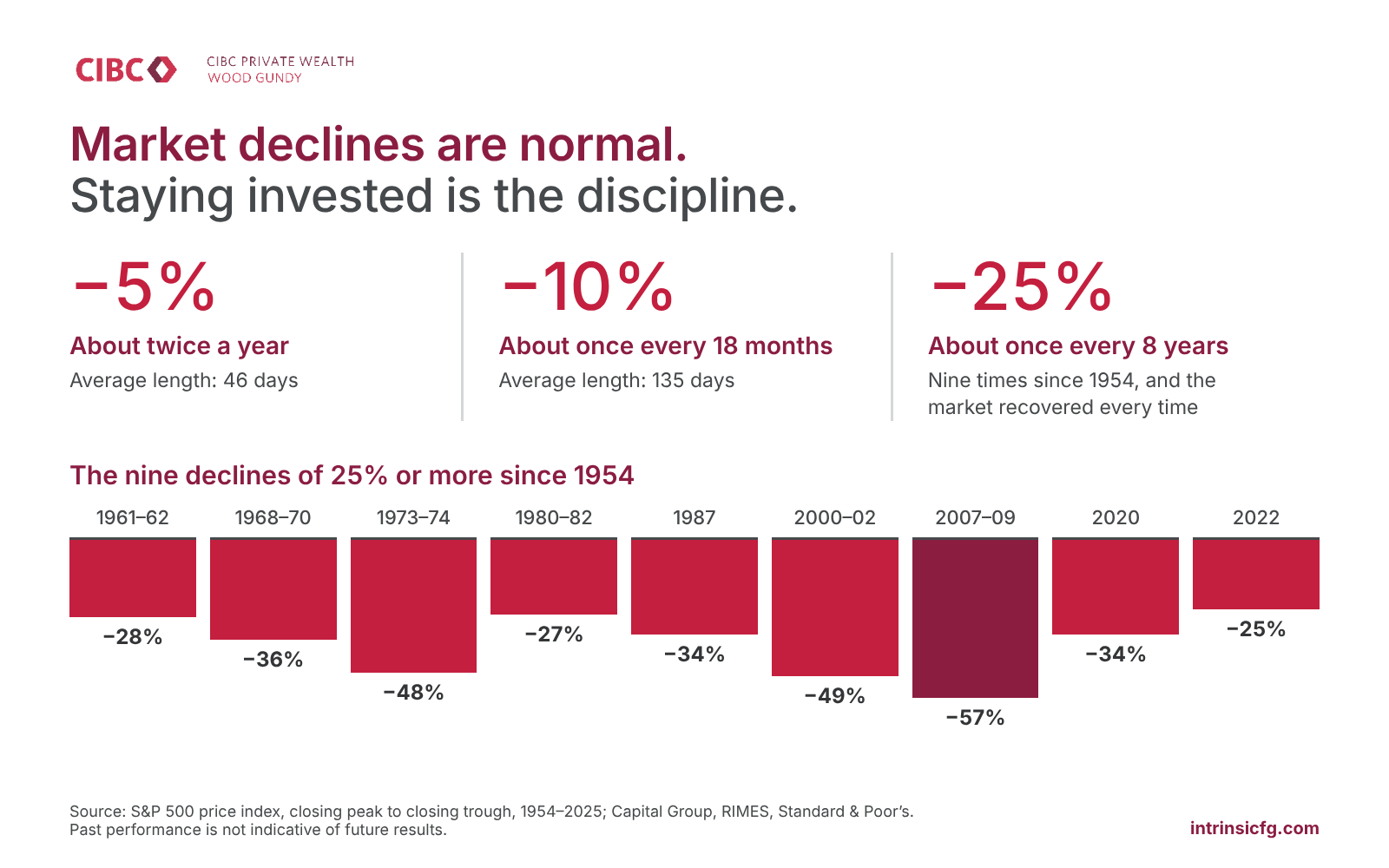
As the above image shows, a decline of 5% or more happens roughly twice a year on average. A 10% correction comes along about once every 18 months. Over a 30-year retirement period, that means approximately 60 pullbacks of 5% and 20 corrections of 10% or more. This is the price of admission for long-term returns. We build your portfolio knowing that these declines are a feature of investing, not a flaw. In other words, they are not a surprise; they are expected.
Earnings Are The Guiding Light
Here's the most important part of this note. While the headlines focus on short-term volatility, corporate America is delivering exceptional results. According to FactSet, 84% of S&P 500 companies have beaten earnings expectations this quarter, with blended year-over-year earnings growth coming in at 31.9% for Q3 2026 - the third consecutive quarter of growth above 25%. Full-year 2026 earnings are projected to grow over 33%. These are outstanding numbers. Markets are forward-looking, and in the long run, stock prices follow earnings, not headlines, not IPOs, and not short-term fear. When businesses are growing profits at this pace and the market is pulling back, it's putting quality companies on sale.
What Are We Doing?
Exactly what you'd expect. We are sharpening our pencils, reviewing our holdings, and identifying high-quality businesses that have been unfairly caught up in the selling. We are not panicking, and we are not making rash changes. We are doing what we have always done in periods like this. Staying disciplined, staying invested, and looking for opportunities. If history has taught us anything, it's that the investors who stay the course during weeks like this are the ones who are rewarded in the months and years that follow. Remember as well that your portfolio is set up with your goals in mind, the market and headlines are not always reflective of your individual returns.
As I’ve said before: Volatility is the price of admission, with the possibility of long-term results. Those returns should be measured over 1,3-,5-and 10-year periods not over a few weeks.