


Skip to Main Content
  • CIBC.com
  • CIBC Private Wealth
  • CIBC Websites
Client Login
  • Home
  • Our Team
  • Commentary
    • Blog
    • Video
    • Market insights
  • Services
    • Our solutions
    • Advisor Managed Account
    • Community
  • Commonly asked questions
  • Contact us
  • CIBC.com
  • CIBC Private Wealth
  • CIBC Websites
  • Client Login
 CIBC Private Wealth, Wood Gundy  CIBC Private Wealth, Wood Gundy

Cacic Wealth Management

  • Home
  • Our Team
  • Commentary
    • Blog
    • Video
    • Market insights
  • Services
    • Our solutions
    • Advisor Managed Account
    • Community
  • Commonly asked questions
  • Contact us

Blog

Address 500 Centre Street SE 27th Floor Calgary AB, T2G 1A6
Telephone Number (403) 508-3230
Email Email us
Email Email
Telephone Number Tel

MILAN CACIC

August 28, 2026

Money Economy Commentary Trending Weekly update Weekly commentary


Facebook
LinkedIn
Twitter

TURNING TARIFFS INTO OPPORTUNITY

The headlines coming out of Washington certainly sound alarming. The U.S. has now imposed a 50% tariff on roughly $28 billion of Canadian goods, and Canada has responded with matching tariffs. For the companies and workers directly affected, this is unquestionably painful.

But it is important to put the number into perspective. The 50% tariff does not apply to everything Canada sells to the United States. Most CUSMA-compliant trade continues to move tariff-free. Even before this latest announcement, the Bank of Canada estimated that industries directly facing the major sectoral tariffs represented only about 1% of Canadian economic output and employment.

In other words, this is a meaningful economic headwind, but it isn't enough on its own to derail the Canadian economy.
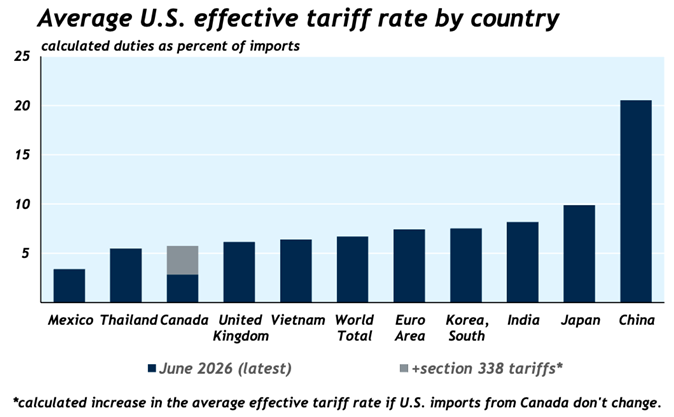
Bar chart titled “Average U.S. effective tariff rate by country,” showing calculated duties as a percent of imports. As of June 2026, Mexico is about 3.5%, Thailand 5.5%, Canada about 3% with an added section 338 tariff increase bringing it to roughly 5.8%, United Kingdom 6.2%, Vietnam 6.4%, world total 6.8%, euro area 7.5%, South Korea 7.6%, India 8.2%, Japan 10%, and China 20.5%, the highest by a wide margin. Footnote says the Canada increase is the calculated effect of section 338 tariffs if U.S. imports from Canada do not change.

Source: U.S. Census Bureau, RBC Economics

More importantly, Canada has an opportunity to turn some of this pressure into something positive.
For decades, one of Canada's biggest economic problems hasn't been a lack of resources, capital
, or opportunity, it has been our inability to actually get major projects built. The federal Major Projects Office now has 18 projects and 9 broader strategies representing approximately $192 billion of new investment, with the potential to unlock roughly $500 billion of future private investment. These include LNG, pipelines, ports, critical minerals, nuclear power, hydroelectricity, transportation corridors, and other major infrastructure.

If there was ever a reason to accelerate these projects, this is it. We cannot control U.S. trade policy. What we can control is whether we build the infrastructure required to sell Canadian energy, minerals, and other resources to the rest of the world.

The tariffs are a problem. But if they finally provide the political urgency required to get hundreds of billions of dollars of Canadian projects built, they could also become a catalyst for something Canada has needed for a very long time.

Sometimes it takes a crisis to turn talk into action.

I have also included some tariff commentary from CIBC’s Global Asset Management team.

As always, if you have any questions, please feel free to give us a call at any time.

Have a great weekend.

Milan

Related posts

MILAN CACIC

August 21, 2026

ARE WE ABOUT TO MISS THE BOAT AGAIN?

Read more

MILAN CACIC

August 14, 2026

A.I. IS GROWING UP!

Read more
 
 
  • Rates
  • FAQ
  • Agreements
  • Trademarks & Disclaimers
  • Privacy & Security
  • CIRO AdvisorReport
  • Accessibility at CIBC
  • Manage Cookie Preferences
  • Cookie Policy
 Canadian Investment Regulatory Organization  Canadian Investor Protection Fund

CIBC Private Wealth” consists of services provided by CIBC and certain of its subsidiaries through CIBC Private Banking; CIBC Private Investment Counsel, a division of CIBC Asset Management Inc. (“CAM”); CIBC Trust Corporation; and CIBC Wood Gundy, a division of CIBC World Markets Inc. (“WMI”). CIBC Private Banking provides solutions from CIBC Investor Services Inc. (“ISI”), CAM and credit products. CIBC Private Wealth services are available to qualified individuals. Insurance services are only available through CIBC Wood Gundy Financial Services Inc. In Quebec, insurance services are only available through CIBC Wood Gundy Financial Services (Quebec) Inc.


CIBC Private Wealth services are available to qualified individuals. The CIBC logo and “CIBC Private Wealth” are trademarks of CIBC, used under license.