




Calvin Tenenhouse
October 07, 2026



Q3 Update and Market Outlook
Similar to Q2,the third quarter of 2026 was marked by heightened geopolitical and macroeconomic tensions. Conflict in the Middle East pushed Brent crude above USD 100 per barrel, while persistent inflation concerns led more than 80% of developed-market central banks to raise policy rates, according to JP Morgan.
Despite these headwinds, the global economy remained resilient, with the U.S. continuing to serve as the primary engine of developed-market growth. Economic activity has been supported by robust business investment and significant AI-related capital expenditure. Consumer spending also held up reasonably well, supported in part by households drawing on savings as real personal income softened.
Fixed income, an asset class not typically associated with market headlines, drew increased investor attention this quarter as bond yields moved higher. This has prompted an important question: what is driving the rise in yields, and what does it mean for portfolios?
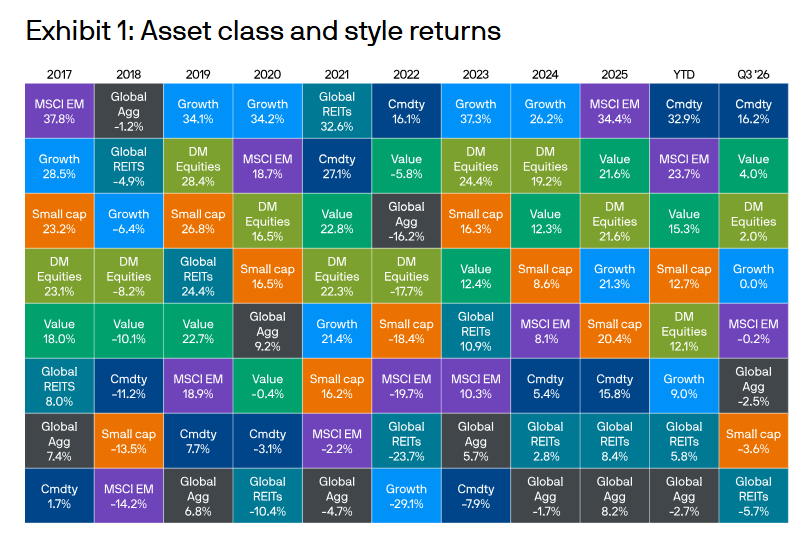
Fixed income, the usually boring asset class, made headlines this quarter as bond yields have moved higher, and many investors are asking the same question: what’s driving the rise in yields and how does this impact my portfolio?
What’s driving higher interest rates?
• Governments and companies are issuing a lot of debt. Heavy borrowing from these large institutions increases the supply of bonds, pushing prices down and yields up.
• Inflation risks are still present. Ongoing conflicts, especially involving Ukraine and Iran, have kept pressure on energy, fuel, and food costs. When investors expect high inflation, they demand higher returns to compensate and protect purchasing power.
• The AI and data center boom is adding to demand and inflation. This trend is supporting growth, but it is also driving large capital needs and contributing to rising costs in areas like memory and infrastructure.
• Tariffs are adding inflation pressure. While tariffs may help government revenues, they can also raise prices.
How does this impact my portfolio?
Higher interest rates generally discourage borrowing, which can help slow inflation and moderate economic growth. They also affect different parts of the economy in different ways:
Housing: Higher rates reduce how much buyers can borrow for a given monthly payment and discourage existing homeowners with low-rate mortgages from moving. This can weigh on home sales and construction-related spending.
Consumer borrowing: Rates on auto loans and other fixed-rate consumer debt tend to rise as lenders’ funding costs increase. Higher rates may also encourage saving and reduce discretionary spending.
Business investment: Higher borrowing costs can make capital-intensive projects, such as data centres, energy infrastructure, and industrial expansion, less attractive. Over time, this may curb investment and earnings growth.
Equities: The impact on stocks is less straightforward. Rising yields reduce the present value investors assign to future earnings. However, if yields are rising because economic growth remains solid, the effect on equities may be more limited.
Current Market Outlook
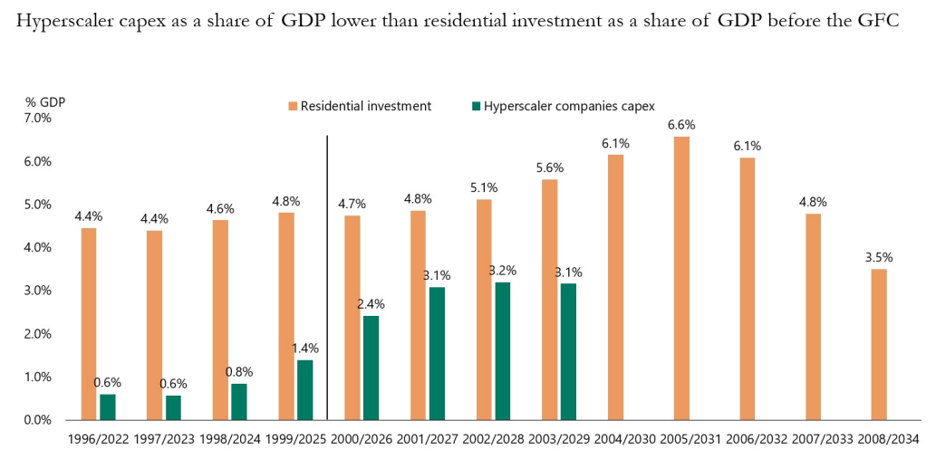
As technology earnings continue to grow, the underlying market is still expensive relative to history, but not as disjointed as the ‘bubble’ expectations and headlines make it seem to be (NVDA trades for 24.9x forward earnings, well below its historical average of 30x). Although hyperscaler Capex may seem large from a dollar standpoint (Yes... $800 Billion is a big number) but the investment into AI as a % of GDP is still much lower than the investment into residential real estate was prior to the financial crisis in ’08.
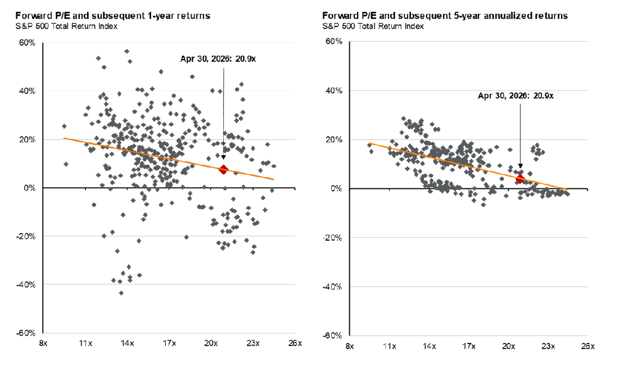
While these higher valuations do not directly correlate to lackluster returns moving forward, they do imply a shorter runway for further multiple expansion and a regression back towards the mean.
We believe the case for continued growth increasingly depends on earnings, where the outlook remains strong. Earnings growth is running well above historical norms, and forward estimates continue to trend higher. Most of the major tech players report this month and the numbers should be good. In some cases, they will be very good. Lastly, bond yields are very attractive and give investors a material source of return without needing to add further risk to the portfolio. In this environment, our fixed income portfolios are positioned with shorter and intermediate maturities which we believe offer the best balance between income and interest-rate risk