







Anchors Aweigh
Investor psychology plays a powerful role in how people perceive market movements, especially around their portfolio’s all-time high. The concept of anchoring—a common behavioral bias—explains how investors fixate on a specific reference point, such as the peak value of their portfolio. Once investors experience that high, it becomes their mental benchmark for success, and any decline from it feels like a loss, even if their portfolio remains significantly higher than where it was months or years earlier.
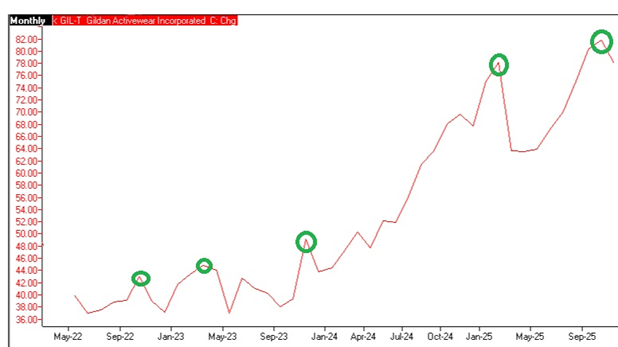
Buyers of Gildan Activewear might remember the late 2023 founder and CEO firing that brought front page business section drama to the company. Along with the negative headlines came share price deterioration. Shares peaked near $50 before falling -20% amidst the drama. Some shareholders who bought in the $35 range felt that seeing the shares at $42 was a ‘loss’ when in reality they were up 20%. “I wish we had sold at $50” was a common refrain.
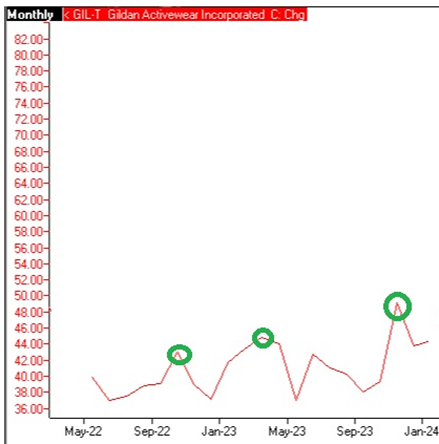
We aligned with several other major shareholders in voting to replace the board of directors and re-instate the ousted CEO. That is exactly what happened and since then the shares have rallied and sit at $78 today (2025-11-11). This is a gain of more than 100% from some of our original purchases. Interestingly it touched $85 before retreating to $78 today – there are probably a few clients who wish we had sold at $85!
This psychological phenomenon of anchoring often leads to frustration, impatience, or risk-averse behavior when stock markets or share prices pull back. Many investors fear market corrections, viewing them as threats rather than natural parts of market cycles. Instead of seeing corrections as opportunities to invest at lower prices, they may hesitate, sell prematurely, or wait anxiously for prices to recover to prior highs. Overcoming this bias requires a long-term mindset—recognizing that markets regularly fluctuate, yet historically trend upward over time.
Much of this angst seems to stem from the misconception among investors that stock market volatility is oscillation along a flat line and that buying and then seeing a dip means a certain loss. We know that this is not the case – the general long term direction of stock prices is an upward sloping line, not a flat one, and buying before negative movement or oscillation, while unfortunate, does not impair capital permanently.
We are seeing similar anchoring behaviour in the housing market in Ontario. The 2020 pandemic and historically low interest rates (0.8% mortgages!) led to a boom in house prices – our advisory group estimated in previous writings that prices were as much as +40% overvalued by the peak in February 2022. March 2022 saw the first of a flurry of interest rate increases, sparking the current trend of declining prices. As we sit today, Ontario home prices are down nearly -25% from their 2022 peak and we think, still falling. The chart below compares the timeline of the current Ontario housing market with the previous Ontario house price collapse in the early 1990s and the US market crash during the financial crisis. When real estate corrects, it often takes the better part of a decade to find its bottom. We’re only 3.5 years in.
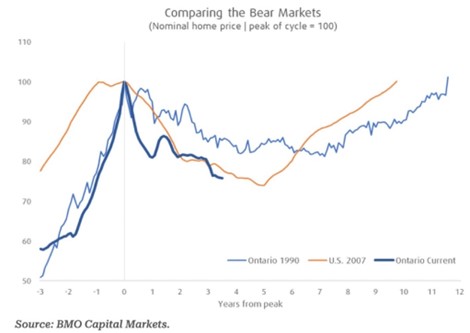
The renewal of mortgages at higher rates is causing a good part of the difficulty for home owners in Ontario, especially investors and speculators who are being forced to sell due to untenable borrowing costs. While we have seen a few Bank of Canada overnight-rate cuts of late, returning to pandemic rates is highly unlikely. Further as we wrote in 2024, fixed rates and the overnight rate do not move in tandem. If you consider that most mortgages in Ontario operate on a 5 year renewal cycle, that would put the renewal of most of the peaky Feb 2022 buys into early 2027. We think it could be as long as late 2027 or even into 2028 when the market finds its bottom.
Many sellers listing their homes today have chosen prices more suitable for Feb 2022...they’ve psychologically anchored on those peak prices. Even if they bought in 2010 and are up 150%, they feel like selling for anything below the 2022 price is a ‘loss’. This would be like trying to sell shares of the stock in the example above at $100 when the market price was $88. Very unlikely to be filled and ignored by the market…that’s what is happening to home sellers stuck in 2022.
Related posts
Brady Clark Advisory Group
January 05, 2026
Fear of Success
All time high's in the market are not something to be scared of, when investing for the long run, it is important to remember that short term volatility will have a limited impact on long-term success...
Read moreBrady Clark Advisory Group
December 02, 2025
The Big Bet on Artificial Intelligence
Big Tech’s aggressive debt push to fund artificial intelligence (AI) data centers is sparking credit jitters . The big question is, will these investments yield the expected efficiencies, and what for...
Read more